Figures
Oscillograms, traces and photographs held against this taxon.
Species
What the sources say about this taxon, as written.
behaviour · bio.acousti.ca
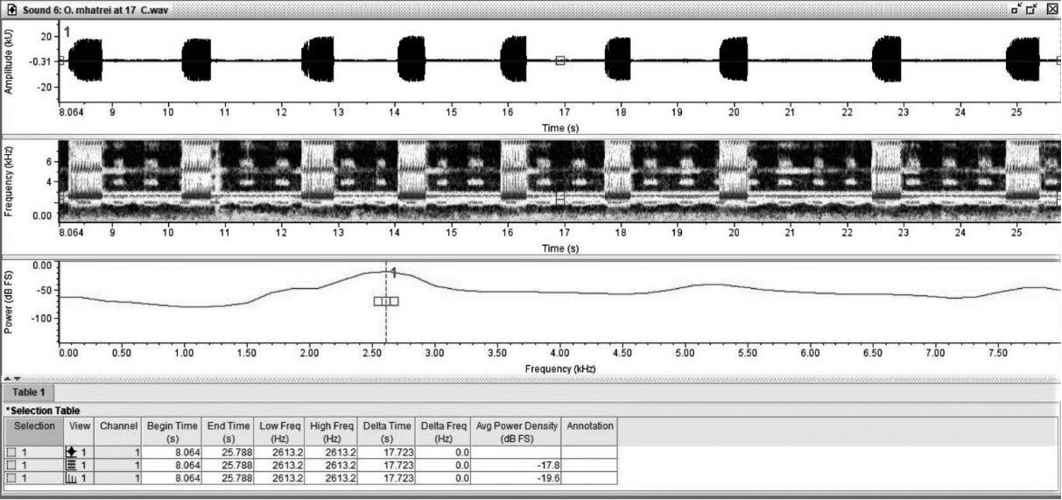
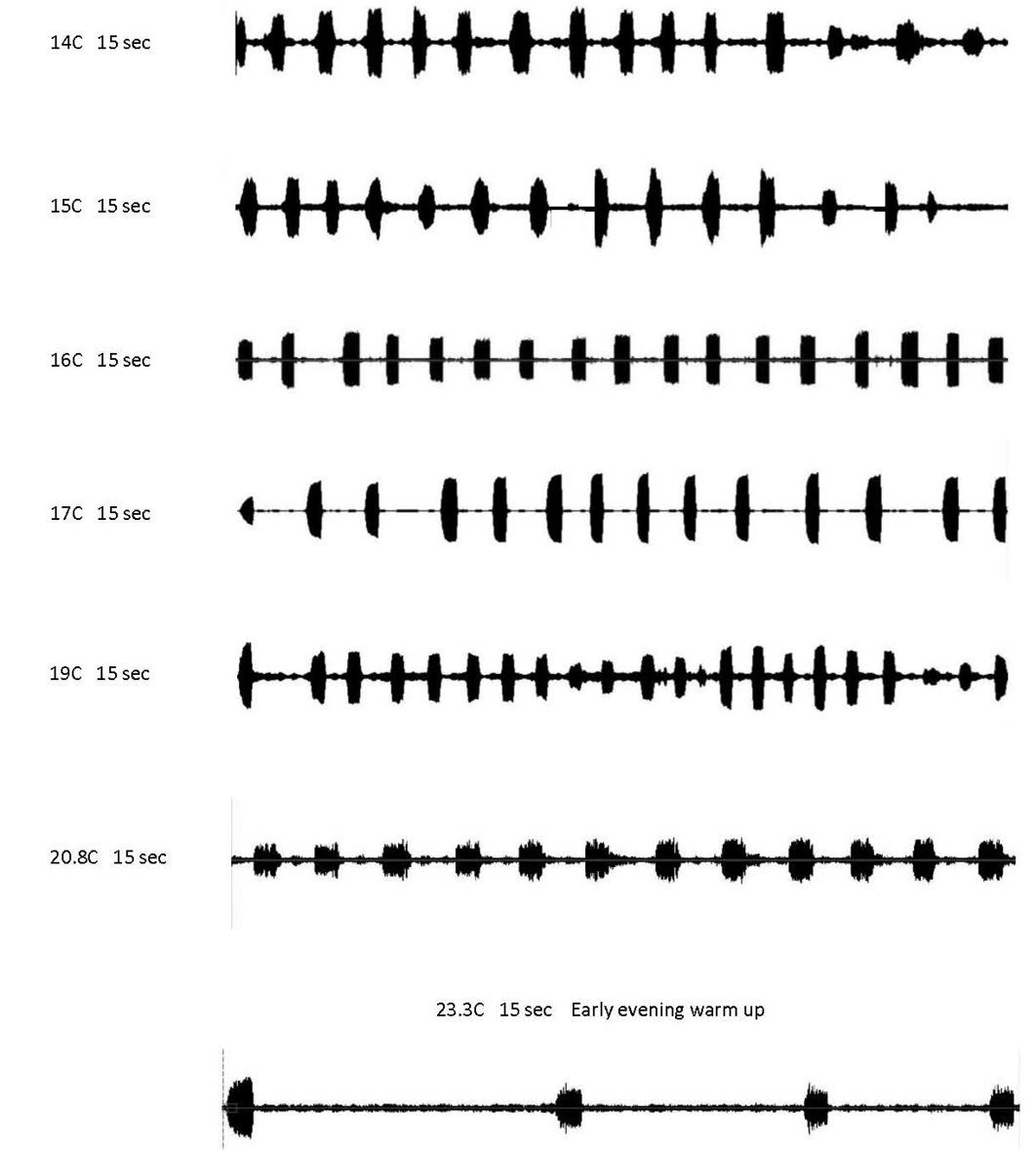
The song pattern and chirp configuration of Otomi tree cricket were instrumental in diagnosing this new Mexican oecanthine. Waveform analysis showed that each chirp was comprised of a long string of pulses with no groupings (Figs 14–16). The recordings taken in the field and in captivity by IMCG were at temperatures of 14°C–19°C. The carrier frequency of the calling song at 17°C was slightly above 2.6 kHz (Fig. 17). One recording revealed the intermittent long chirp song of interest with a faster chirping species in the background (Fig. 18). The faster chirping was 3–4 times faster than the long chirping of this new species, affirming the slow rate of the target species while the highly regular spacing of the background singer affirmed the irregular pattern of Otomi tree cricket. The irregular chirping pattern and the ungrouped chirp configuration of this new species were compared to the patterns and configurations of four other chirping species, two intermittent trilling species, and one continuous trilling species (Fig. 19). The four chirping species in the rileyi species group display grouping of their pulses. Oecanthus varicornis, from the varicornis species group, has continuous trilling with runs of pulses over several seconds, while O. mhatreae sp. nov. chirps never exceed 0.7 second. Of the three intermittent bursts of trilling species, O. niveus has a J-shaped mark on the scape (Walker 1962). The second species, O. exclamationis, has markings on the pedicel and scape that resemble an inverted exclamation mark (Fulton 1915). The third intermittent bursts of trilling species, O. leptogrammus, does have an irregular pattern similar to O. mhatreae sp. nov.; however, the coloring and antennal markings are markedly different for these two species. Oecanthus leptogrammus is very pale green (Collins et al. 2014) and has a thin black line on each pedicel and scape (Walker 1962). At all temperatures, the chirping pattern of Otomi tree cricket was irregular. This sporadic rate and pattern were unlike any of the other known chirping species in North America. Fig. 20 shows the irregular rate at a variety of temperatures and includes a sample of the early evening warm up song heard most evenings. Since Otomi tree cricket has an irregular chirping pattern, a trend line graph cannot reliably be used for comparison with chirpers with regular patterns. The chirp rate at recorded temperatures was plotted for comparison to the other known songs (Walker 2019b, Cornell Lab 2019) of North American chirping species (Fig. 21, Table 1). The graph displays the general niche that each of these five species occupy.
9 in audioBlast.
Oscillograms, traces and photographs held against this taxon.
Counts are recordings at or below each taxon, so an empty branch shows as empty before you click it. A dash means the join view holds no column for that rank and cannot roll up to it.
Publications audioBlast links to this taxon.
The rows audioBlast holds for this taxon, each matched to the same Catalogue of Life node. Where a source classifies it differently, its own classification is kept.
| Source | Its name | Its rank | Its family | Record |
|---|---|---|---|---|
| bio.acousti.ca | Oecanthus mhatreae | Species | Gryllidae | bio.acousti.ca/6831 |
| iNaturalist | Oecanthus mhatreae | Species | Oecanthidae | iNaturalist/930233 |
Bioschemas is in the head of this page. The Darwin Core RDF lives at the API address below, which negotiates JSON-LD and Turtle.
{
  "@context": [
    "https://schema.org/",
    {
      "dwc": "http://rs.tdwg.org/dwc/terms/"
    }
  ],
  "@type": "Taxon",
  "@id": "https://browse.acousti.cloud/taxon/oecanthus-mhatreae/",
  "name": "Oecanthus mhatreae",
  "taxonRank": "species",
  "url": "https://browse.acousti.cloud/taxon/oecanthus-mhatreae/",
  "sameAs": "https://api.audioblast.org/taxon/CoL/8Q2JB",
  "parentTaxon": {
    "@type": "Taxon",
    "name": "Oecanthus",
    "taxonRank": "genus",
    "url": "https://browse.acousti.cloud/taxon/oecanthus/"
  }
}