Figures
Oscillograms, traces and photographs held against this taxon.
Species
What the sources say about this taxon, as written.
behaviour · bio.acousti.ca
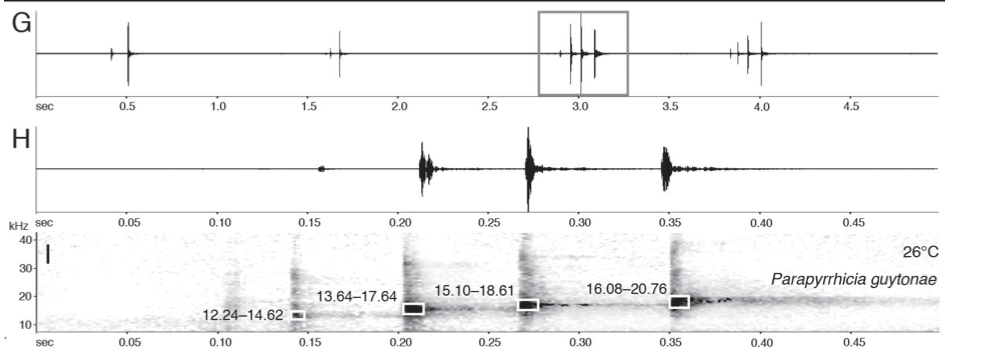
The call of P. guytonae consists of a series of short, 2–5 syllable echemes and is unique in the frequency modulated aspect of the echemes; mean syllable duration is 0.0047 s (SD=0.00182, n=57) (Figs. 53G, H). Within each echeme the first syllable starts with the dominant frequency of 12.24–16.99 kHz (mean 14.88 kHz) and each successive syllable progressively increases its dominant frequency by approximately 2 kHz, with the last syl- lable reaching 18.16–22.26 kHz (mean 20.0 kHz) (Fig. 55I). It is possible that the function of such frequency shift is similar to that discussed by Heller & Hemp (2017) for Gonatoxia helleri, which apparently serves to mimic the call of a female in order to make it more difficult to locate her for other conspecific males. Females of P. guytonae have well developed stridulatory files on the posterior margin of the right tegmen, which implies a call-and-response behavior in this species. Unfortunately, the female call is yet unknown.
this account at bio.acousti.ca
general · bio.acousti.ca
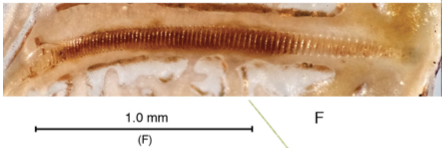
Stridulatory file flat, weakly bent, 1.8 mm long, 0.1 mm wide, with 83 teeth (Fig. 33F)
6 measurements across 6 traits. Each name links to its term in the audioBlast vocabulary.
Every value behind the summaries above. Each links to its own record in the API, which carries the reference it was taken from.
| Trait | Value | Call | Part | Sex | Temp. | Source |
|---|---|---|---|---|---|---|
| Song Structure | Echemes | Calling Song | Male | bio.acousti.ca | ||
| Number Of Teeth On Stridulatory File | 83 | Male | bio.acousti.ca | |||
| Width of Stridulatory File | 0.1 | Male | bio.acousti.ca | |||
| Length Of Stridulatory File | 1.8 | Male | bio.acousti.ca | |||
| Syllables per Echeme | 2-5 | Calling Song | Male | bio.acousti.ca | ||
| Peak Frequency (kHz) | 12.24-22.6 | Calling Song | Male | bio.acousti.ca |
Oscillograms, traces and photographs held against this taxon.
Counts are recordings at or below each taxon, so an empty branch shows as empty before you click it. A dash means the join view holds no column for that rank and cannot roll up to it.
Publications audioBlast links to this taxon.
The rows audioBlast holds for this taxon, each matched to the same Catalogue of Life node. Where a source classifies it differently, its own classification is kept.
| Source | Its name | Its rank | Its family | Record |
|---|---|---|---|---|
| bio.acousti.ca | Parapyrrhicia guytonae | Species | Tettigoniidae | bio.acousti.ca/6958 |
Bioschemas is in the head of this page. The Darwin Core RDF lives at the API address below, which negotiates JSON-LD and Turtle.
{
  "@context": [
    "https://schema.org/",
    {
      "dwc": "http://rs.tdwg.org/dwc/terms/"
    }
  ],
  "@type": "Taxon",
  "@id": "https://browse.acousti.cloud/taxon/parapyrrhicia-guytonae/",
  "name": "Parapyrrhicia guytonae",
  "taxonRank": "species",
  "url": "https://browse.acousti.cloud/taxon/parapyrrhicia-guytonae/",
  "sameAs": "https://api.audioblast.org/taxon/CoL/8Q2WC",
  "parentTaxon": {
    "@type": "Taxon",
    "name": "Parapyrrhicia",
    "taxonRank": "genus",
    "url": "https://browse.acousti.cloud/taxon/parapyrrhicia/"
  }
}