Figures
Oscillograms, traces and photographs held against this taxon.
Species
What the sources say about this taxon, as written.
behaviour · bio.acousti.ca
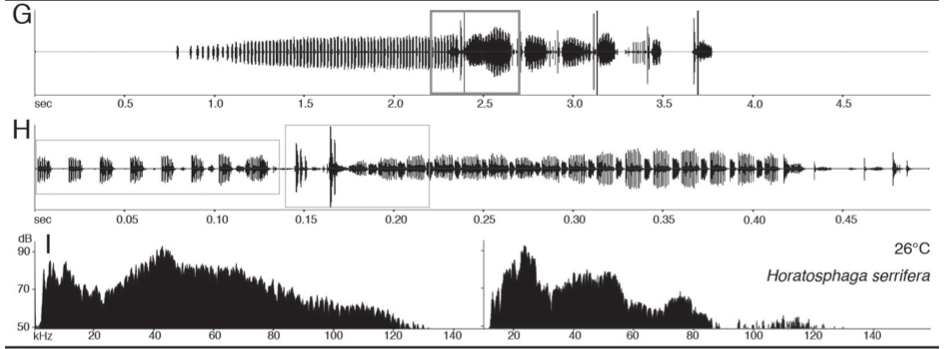
As discussed by Hemp et al. (2010), the call of Acrometopini is often complex, making it difficult to apply the traditional terminology of syllables and echemes to describe it. For this reason, it is preferable to use the term ‘element’ for a more or less fixed sequence of sound events, without attempting to distinguish the sections of the call are the products of full closing or opening of the stridulatory structures. H. serrifera males call from elevated perches and every few minutes fly to another perch, usually a tall herbaceous plant, and start a new bout of calling. The call, lasting on average 1.6–3.0 seconds, is divided into two sections, each with a different frequency spectrum (Fig. 52G). The first section is a uniform train of similar, short syllables produced at the rate of 60–80/sec; mean syllable duration is 0.0094 s (SD=0.001325, n=75); the peak fre- quency of this section of the call is 4.7–9.9 kHz (Figs. 52H, I). The first section, which lasts approximately 0.1–1.0 s, is immediately followed by a more complex section with multiple elements of various duration; some elements resemble long echemes with similar peak frequency as the first section, while others are short clicks (mean duration 0.011 s) with the peak frequency of 12.9–14.0 kHz (Figs. 52H, I).
8 measurements across 6 traits. Each name links to its term in the audioBlast vocabulary.
Every value behind the summaries above. Each links to its own record in the API, which carries the reference it was taken from.
| Trait | Value | Call | Part | Sex | Temp. | Source |
|---|---|---|---|---|---|---|
| Peak Frequency (kHz) | 12.9-14.0 | Calling Song B | B | bio.acousti.ca | ||
| 4.7-9.9 | Calling Song A | A | Male | bio.acousti.ca | ||
| Call duration (s) | 1.6-3.0 | Calling Song | Male | bio.acousti.ca | ||
| 0.1-1.0 | Calling Song A | A | Male | bio.acousti.ca | ||
| Song Structure | Syllables | Calling Song A | A | Male | bio.acousti.ca | |
| Syllable Duration (song is syllable sequence) | 0.0094 | Calling Song A | A | Male | bio.acousti.ca | |
| Pattern of Component Calls | AB | Calling Song | Male | bio.acousti.ca | ||
| Syllable Repetition Rate (Repeated Syllables in Song) | 60-80 | Calling Song A | A | Male | bio.acousti.ca |
Oscillograms, traces and photographs held against this taxon.
Counts are recordings at or below each taxon, so an empty branch shows as empty before you click it. A dash means the join view holds no column for that rank and cannot roll up to it.
Publications audioBlast links to this taxon.
The rows audioBlast holds for this taxon, each matched to the same Catalogue of Life node. Where a source classifies it differently, its own classification is kept.
| Source | Its name | Its rank | Its family | Record |
|---|---|---|---|---|
| bio.acousti.ca | Horatosphaga serrifera | Species | Tettigoniidae | bio.acousti.ca/6953 |
Bioschemas is in the head of this page. The Darwin Core RDF lives at the API address below, which negotiates JSON-LD and Turtle.
{
  "@context": [
    "https://schema.org/",
    {
      "dwc": "http://rs.tdwg.org/dwc/terms/"
    }
  ],
  "@type": "Taxon",
  "@id": "https://browse.acousti.cloud/taxon/horatosphaga-serrifera/",
  "name": "Horatosphaga serrifera",
  "taxonRank": "species",
  "url": "https://browse.acousti.cloud/taxon/horatosphaga-serrifera/",
  "sameAs": "https://api.audioblast.org/taxon/CoL/3MNR9",
  "parentTaxon": {
    "@type": "Taxon",
    "name": "Horatosphaga",
    "taxonRank": "genus",
    "url": "https://browse.acousti.cloud/taxon/horatosphaga/"
  }
}