Figures
Oscillograms, traces and photographs held against this taxon.
What the sources say about this taxon, as written.
behaviour · bio.acousti.ca
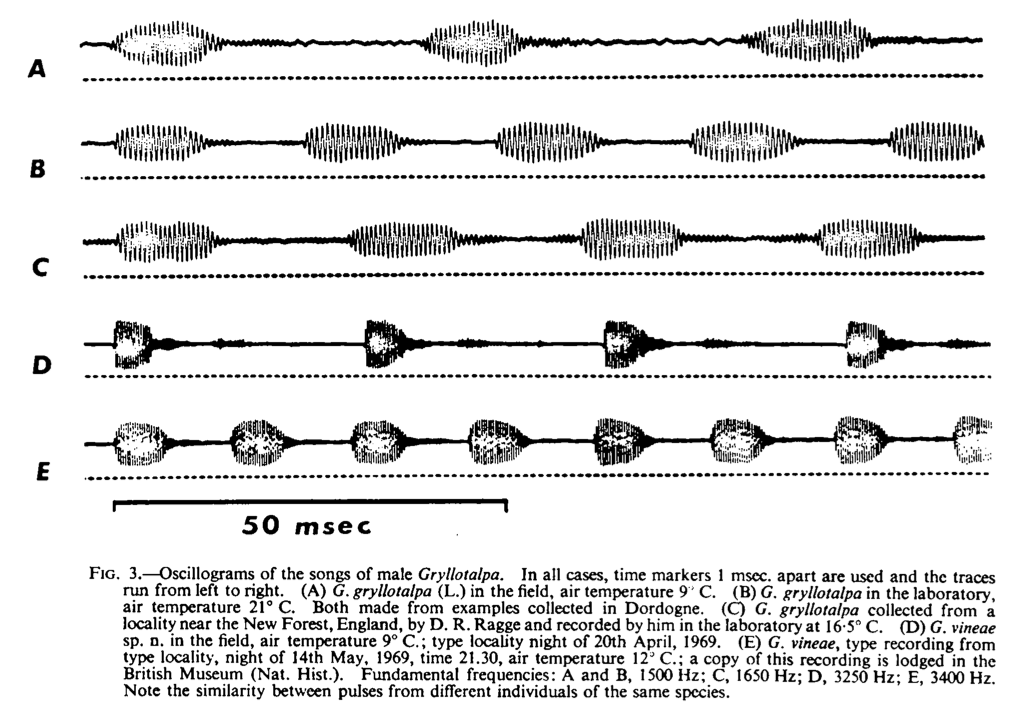
Calling song fundamental frequency 3512 +/- 107 Hz, n = 33, pulse length 6-8 msec., pulse interval 30 msec. at 9oC. to 14 msec at 14oC. but also dependent on time after start of singing period (fig. 3D and 3E). Song a continuous trill of musical note A7 ASA. Intensity of song 2 to 10 x W.m.-a (83 to 90dB) at 1 m. vertically above mouths of burrow. Singing burrow with two openings each 30 mm. diarn., separated by a distance, centre to centre, of 40mm. Passages leading to surface merge about 45 mm. below surface. The common passage runs horizontally for about 40mm. and then opens into a spherical chamber about 30 mm. diam.. from which a tunnel about I5 mm. diam. communicates with rest of burrow. Burrow flares exponen- tially out from spherical chamber, its cross sectional area doubling about every I5rnm. of its length (fig. 4D, E and F).
this account at bio.acousti.ca
behaviour · bio.acousti.ca
Le chant est fort, désagréable, et audible à 200 m.
35 measurements across 12 traits. Each name links to its term in the audioBlast vocabulary.
Every value behind the summaries above. Each links to its own record in the API, which carries the reference it was taken from.
| Trait | Value | Call | Part | Sex | Temp. | Source |
|---|---|---|---|---|---|---|
| Peak Frequency (kHz) | 6.85 | Call | bio.acousti.ca | |||
| 3.49 | Call | bio.acousti.ca | ||||
| 3.45 | Call | bio.acousti.ca | ||||
| 3.49 | Call | bio.acousti.ca | ||||
| 3.49 | Call | bio.acousti.ca | ||||
| 3.4 | Calling Call | Male | bio.acousti.ca | |||
| 3.512±0.107 | Calling Call | Male | bio.acousti.ca | |||
| 3.0-5.0 | Calling Call | Male | bio.acousti.ca | |||
| 3.4453125-3.5314453125 | Call | bio.acousti.ca | ||||
| 3.4453125-3.5314453125 | Call | bio.acousti.ca | ||||
| 3.40224609375-3.48837890625 | Call | bio.acousti.ca | ||||
| 3.4453125-3.5314453125 | Call | bio.acousti.ca | ||||
| 6.76142578125-6.9767578125 | Call | bio.acousti.ca | ||||
| Frequency Spectrum (50%) (kHz) | 3.45-3.53 | Call | bio.acousti.ca | |||
| 3.45-3.53 | Call | bio.acousti.ca | ||||
| 3.4-3.49 | Call | bio.acousti.ca | ||||
| 3.45-3.53 | Call | bio.acousti.ca | ||||
| 6.72-7.02 | Call | bio.acousti.ca | ||||
| Frequency Spectrum (25%) (kHz) | 3.4-3.57 | Call | bio.acousti.ca | |||
| 3.45-3.57 | Call | bio.acousti.ca | ||||
| 3.36-3.53 | Call | bio.acousti.ca | ||||
| 3.4-3.53 | Call | bio.acousti.ca | ||||
| 6.68-7.11 | Call | bio.acousti.ca | ||||
| Sound Propagation Distance (m) | 500 | Calling Call | Male | bio.acousti.ca | ||
| 200 | Calling Call | Male | bio.acousti.ca | |||
| Syllable Interval | 0.030 | Calling Call | Male | 9 | bio.acousti.ca | |
| 0.009 | Calling Call | Male | 14 | bio.acousti.ca | ||
| Syllable Duration (song is syllable sequence) | 0.06-0.08 | Calling Call | Male | bio.acousti.ca | ||
| 0.006-0.012 | Calling Call | Male | bio.acousti.ca | |||
| Crepitation (Presence) | Absent | Male; Female | bio.acousti.ca | |||
| Sound Production Method | Elytral Stridulation | bio.acousti.ca | ||||
| Song Structure | Syllables | Calling Call | Male | bio.acousti.ca | ||
| Acoustic Burrow (Presence) | Present | Male | bio.acousti.ca | |||
| Time Of Day Of Call | Night | Calling Call | Male | bio.acousti.ca | ||
| Syllable Repetition Rate (Continuous Song) (Hz) | 35-90 | Calling Call | Male | bio.acousti.ca |
804 in audioBlast.
792 more in the audioBlast browser.
Regions of a recording marked as this taxon, by a person or by an algorithm.
| Recording | From | To | Type | Annotator | Record |
|---|---|---|---|---|---|
| 10753 | 0 | 44 | Voice Introduction | Edward Baker | view |
| 10753 | 44 | 53 | Call | Edward Baker | view |
| 10754 | 0 | 4 | Voice Introduction | Edward Baker | view |
| 10754 | 5 | 23 | Call | Edward Baker | view |
| 10755 | 0 | 39 | Voice Introduction | Edward Baker | view |
| 10755 | 38 | 60 | Call | Edward Baker | view |
| 10756 | 0 | 3 | Voice Introduction | Edward Baker | view |
| 10756 | 4 | 34 | Call | Edward Baker | view |
Oscillograms, traces and photographs held against this taxon.
Counts are recordings at or below each taxon, so an empty branch shows as empty before you click it. A dash means the join view holds no column for that rank and cannot roll up to it.
Publications audioBlast links to this taxon.
The rows audioBlast holds for this taxon, each matched to the same Catalogue of Life node. Where a source classifies it differently, its own classification is kept.
| Source | Its name | Its rank | Its family | Record |
|---|---|---|---|---|
| bio.acousti.ca | Gryllotalpa vineae | Species | Gryllotalpidae | bio.acousti.ca/247 |
| iNaturalist | Gryllotalpa vineae | Species | Gryllotalpidae | iNaturalist/503713 |
Bioschemas is in the head of this page. The Darwin Core RDF lives at the API address below, which negotiates JSON-LD and Turtle.
{
  "@context": [
    "https://schema.org/",
    {
      "dwc": "http://rs.tdwg.org/dwc/terms/"
    }
  ],
  "@type": "Taxon",
  "@id": "https://browse.acousti.cloud/taxon/gryllotalpa-vineae/",
  "name": "Gryllotalpa vineae",
  "taxonRank": "species",
  "url": "https://browse.acousti.cloud/taxon/gryllotalpa-vineae/",
  "sameAs": "https://api.audioblast.org/taxon/CoL/3HGFW",
  "alternateName": [
    "la Courtiliêre des vignes",
    "Vineyard Mole-cricket"
  ],
  "parentTaxon": {
    "@type": "Taxon",
    "name": "Gryllotalpa",
    "taxonRank": "genus",
    "url": "https://browse.acousti.cloud/taxon/gryllotalpa/"
  }
}