Figures
Oscillograms, traces and photographs held against this taxon.
Species
What the sources say about this taxon, as written.
behaviour · bio.acousti.ca
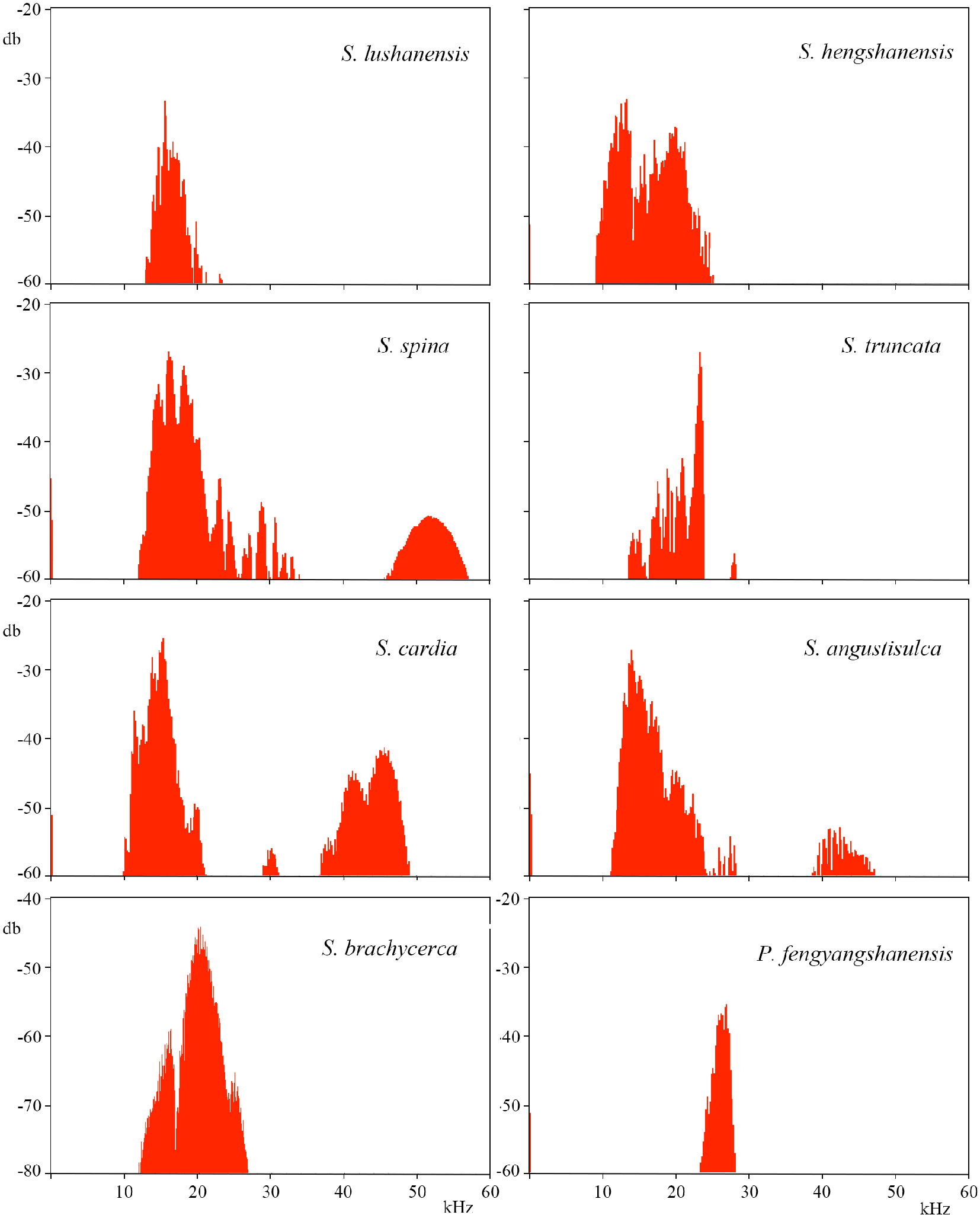
The male calling songs of all investigated species in Sinocyrtaspis can only be heard during night when the temperature is slightly lower than during the daytime. The calling song (Fig. 7) consisted of isolated syllables separated from each other by irregular intervals with syllable repetition rates from 0.2 to 0.8 Hz (Table S2 in File S1). In the recordings, isolated sylla- bles can be divided into three parts: soft beginning, main and echo part. From the soft beginning, the amplitude of the elements gradually increased, followed by the main part in which the amplitude of elements rose from small to large and then to small again, and finally the echo part which has the smallest amplitude produced by echoes from surroundings. According to the oscillograms, the outgroup P. fengyang- shanensis can be distinguished easily from Sinocyrtaspis species (Fig. 7). The calling song of each species in Sinocyrtaspis had some similarities as well as differences. In S. truncata, the posterior area of the main part of the song has a special element which other songs do not possess (but see Discussion), whereas S. lushanensis had a long and small amplitude in the end which could be an echo produced by a wall. In S. cardia, some isolate syllables are without soft beginning, which suggests that this part may be unimportant in species recognition. The songs of all Sinocyrtaspis species have a large proportion in the ultrasonic range, but the peak frequencies were mainly in the audible range (<20 kHz) except in S. truncata (23 kHz; Table S2) whereas the peak frequency of the outgroup species P. fengyangshanensis was 27 kHz which is inaudible for people. The largest bandwidth was observed in S. spina with a second peak frequency at 51 kHz. The bandwidth of S. hengshanensis was close to that of S. brachycerca (Fig. 8).
this account at bio.acousti.ca
behaviour · bio.acousti.ca
Putting S. truncata aside, the song structure is relatively similar throughout the genus and it is a little difficult to divide elements within isolated syllables. In the most simple cases, a tettigoniid syllable is made of heavily damped impulses, which obviously is not the case here; likewise, for crickets, a syllable is made of a long impulse, as is not the case here either. The elements within syllables in Sinocyrtaspis spp. appear to be an admixture of heavily damped and long syllables. Montealegre-Z et al. (2006) ana- lyzed a brachypterous species in Meconematinae from South America, and defined its syllable type as SSTP (short spaced tonal pulses). But the impulses in Sinocyrtaspis are slightly different; a high-amplitude impulse follows a low one, so it is a short spaced compound pulse (SSCP) instead of a tonal impulse. If species with similar songs occurred in the same area, it would be hard to perform acoustic separation (Hemp & Heller, 2017). As for Sinocyrtaspis species, overlapping distribution were not found in the field. Species with similar calling songs but morphological differences suggest allopatric speciation based on genitalic differentiation in Sinocyrtaspis (see Çıplak et al., 2009). The peak frequencies of Sinocyrtaspis species are >10 kHz, and ultrasonic frequencies account for a large proportion (Fig. 8). The ultrasonic bandwidth of each species is obvi- ously different. For example, S. truncata has an unusually high peak frequency, but the recordings of this species should be re-confirmed; according to the sonogram (Fig. S4), the acous- tic signal contained elements with different frequencies, partly even more strongly frequency modulated, and thus very likely to be produced by a bat or another mammal rather than an insect. Heller & Hemp (2018) pointed out that large species produce sounds with lower peak frequency compared with small species. The body size of P. fengyangshanensis is smaller than the species in Sinocytraspis, and the peak frequency of the species is distinctly higher and frequency bandwidth narrower than in Sinocyrtaspis (Fig. 8). In a study on another species with inflated pronotum, Heller (2004) suggested, based on the study of Morris & Mason (1995), that the space between tegmina and inflated pronotum may act as a Helmholtz resonator. Such species have a broarder song spectrum when the inflated pronotum is removed (Jons- son et al., 2017). However, although some species have strongly inflated pronotum, their spectral bandwidth is larger than in other species. Based on that, Kaya et al. (2018) assumed that an inflated pronotum may protect tegmina. The pronotum of the male in Sinocyrtaspis is rather strikingly elevated in metazona. When recording calling songs in the field, the present authors observed that the male pronotum was lifted up, almost perpen- dicular to the body (Fig. S2), and the spectrum bandwidth was wider than in P. fengyangshanensis in which the male prono- tum is not raised in metazona. Based on these observations, it is speculated that the elevated male pronotum at metazona is used to protect tegmina. To decide whether this special pronotum acts as a Helmholtz resonator or not, further research is needed.
Oscillograms, traces and photographs held against this taxon.
Counts are recordings at or below each taxon, so an empty branch shows as empty before you click it. A dash means the join view holds no column for that rank and cannot roll up to it.
Publications audioBlast links to this taxon.
The rows audioBlast holds for this taxon, each matched to the same Catalogue of Life node. Where a source classifies it differently, its own classification is kept.
| Source | Its name | Its rank | Its family | Record |
|---|---|---|---|---|
| bio.acousti.ca | Pseudocosmetura fengyangshanensis | Species | Tettigoniidae | bio.acousti.ca/6813 |
Bioschemas is in the head of this page. The Darwin Core RDF lives at the API address below, which negotiates JSON-LD and Turtle.
{
  "@context": [
    "https://schema.org/",
    {
      "dwc": "http://rs.tdwg.org/dwc/terms/"
    }
  ],
  "@type": "Taxon",
  "@id": "https://browse.acousti.cloud/taxon/pseudocosmetura-fengyangshanensis/",
  "name": "Pseudocosmetura fengyangshanensis",
  "taxonRank": "species",
  "url": "https://browse.acousti.cloud/taxon/pseudocosmetura-fengyangshanensis/",
  "sameAs": "https://api.audioblast.org/taxon/CoL/4NV2D",
  "parentTaxon": {
    "@type": "Taxon",
    "name": "Pseudocosmetura",
    "taxonRank": "genus",
    "url": "https://browse.acousti.cloud/taxon/pseudocosmetura/"
  }
}