Figures
Oscillograms, traces and photographs held against this taxon.
Species
What the sources say about this taxon, as written.
behaviour · bio.acousti.ca
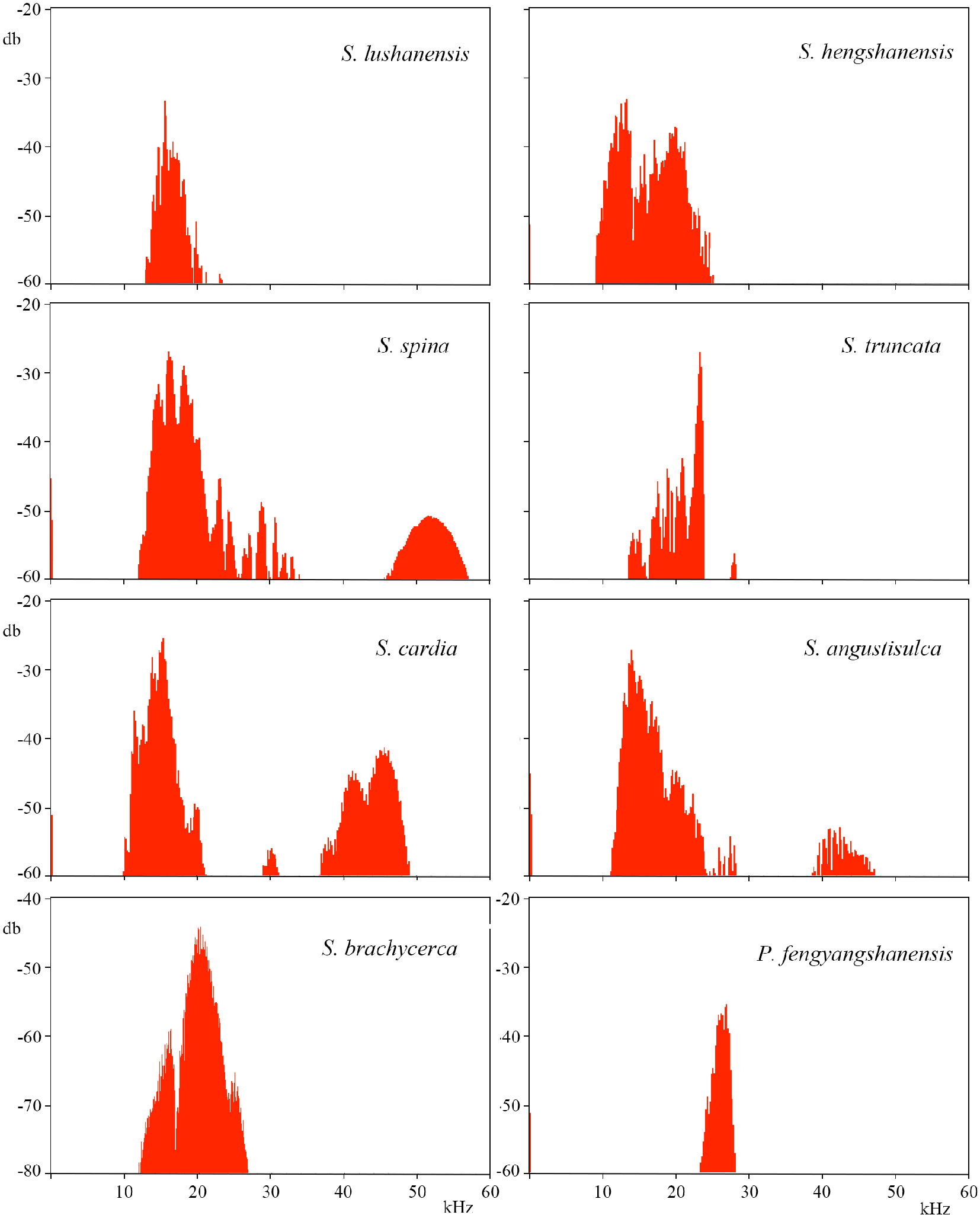
The male calling songs of all investigated species in Sinocyrtaspis can only be heard during night when the temperature is slightly lower than during the daytime. The calling song (Fig. 7) consisted of isolated syllables separated from each other by irregular intervals with syllable repetition rates from 0.2 to 0.8 Hz (Table S2 in File S1). In the recordings, isolated sylla- bles can be divided into three parts: soft beginning, main and echo part. From the soft beginning, the amplitude of the elements gradually increased, followed by the main part in which the amplitude of elements rose from small to large and then to small again, and finally the echo part which has the smallest amplitude produced by echoes from surroundings. According to the oscillograms, the outgroup P. fengyang- shanensis can be distinguished easily from Sinocyrtaspis species (Fig. 7). The calling song of each species in Sinocyrtaspis had some similarities as well as differences. In S. truncata, the posterior area of the main part of the song has a special element which other songs do not possess (but see Discussion), whereas S. lushanensis had a long and small amplitude in the end which could be an echo produced by a wall. In S. cardia, some isolate syllables are without soft beginning, which suggests that this part may be unimportant in species recognition. The songs of all Sinocyrtaspis species have a large proportion in the ultrasonic range, but the peak frequencies were mainly in the audible range (<20 kHz) except in S. truncata (23 kHz; Table S2) whereas the peak frequency of the outgroup species P. fengyangshanensis was 27 kHz which is inaudible for people. The largest bandwidth was observed in S. spina with a second peak frequency at 51 kHz. The bandwidth of S. hengshanensis was close to that of S. brachycerca (Fig. 8).
Oscillograms, traces and photographs held against this taxon.
Counts are recordings at or below each taxon, so an empty branch shows as empty before you click it. A dash means the join view holds no column for that rank and cannot roll up to it.
Publications audioBlast links to this taxon.
The rows audioBlast holds for this taxon, each matched to the same Catalogue of Life node. Where a source classifies it differently, its own classification is kept.
| Source | Its name | Its rank | Its family | Record |
|---|---|---|---|---|
| bio.acousti.ca | Sinocyrtaspis brachycerca | Species | Tettigoniidae | bio.acousti.ca/6808 |
Bioschemas is in the head of this page. The Darwin Core RDF lives at the API address below, which negotiates JSON-LD and Turtle.
{
  "@context": [
    "https://schema.org/",
    {
      "dwc": "http://rs.tdwg.org/dwc/terms/"
    }
  ],
  "@type": "Taxon",
  "@id": "https://browse.acousti.cloud/taxon/paracosmetura-brachycerca/",
  "name": "Paracosmetura brachycerca",
  "taxonRank": "species",
  "url": "https://browse.acousti.cloud/taxon/paracosmetura-brachycerca/",
  "sameAs": "https://api.audioblast.org/taxon/CoL/9H3KQ",
  "parentTaxon": {
    "@type": "Taxon",
    "name": "Paracosmetura",
    "taxonRank": "genus",
    "url": "https://browse.acousti.cloud/taxon/paracosmetura/"
  }
}