Species
What the sources say about this taxon, as written.
behaviour · bio.acousti.ca
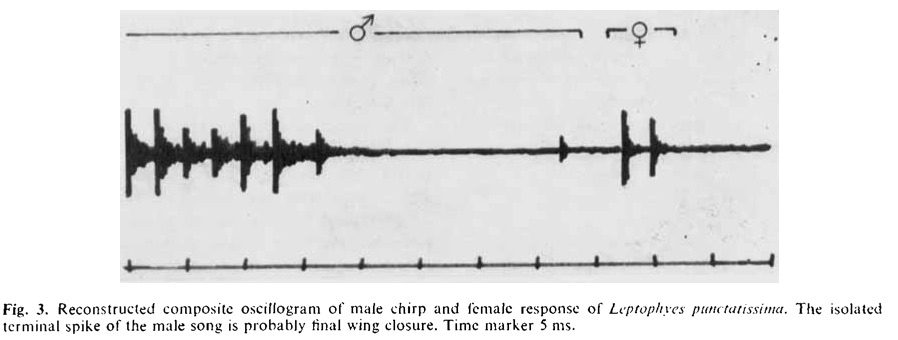
The male calling song consists of isolated faint 'tick'-like syllables repeated at very variable intervals. Sometimes they are repeated quite regularly every few seconds for long periods (intervals of 1-5 s are commomn), but t other times the intervals may be much longer and occassionally the syllables may be grouped into short sequences during which the repetition rate may be as high as 2/s; generally the syllables are repeated more rapidly at higher temperatures. The number of tooth-impacts within each syllable also varies greatly: 4-6 is common, but as few as 1 or as many as 9 sometimes occur. Frequently the main group of impacts (which is a closing hemisyllable) is followed after a variable interval (usually between 15 and 100 ms) by another one (rarely two), probably produced by a further closure of the fore wings. A hemisyllable of 4-6 impacts usually lasts between 8 and 20 ms. The song is produced both suring the day and at night, but seldom durting the first few daylight hours of the morning.
this account at bio.acousti.ca
behaviour · bio.acousti.ca
The song, produced in the evening and at night, is hardly louder than in L. albovittata; one canheear it from about 50cm. It also consists of a sequence of soft 'zb'-sounds. The intervals bertween the syllables are, however, somewhat shorter (about 3-6 sec. at room temperasture).
this account at bio.acousti.ca
behaviour · bio.acousti.ca
The male calling song consists of single, short syllables presented at intervals of several seconds. The acoustical response behaviour of the female was studied intensively by Hartley and Robinson (1976), Robinson (1980), Robinson et al. (1986) and Zimmermann et al. (1989). Robinson et al. (1986) gave detailed information about the latency times. Here we add data on the temperature dependency of this behaviour (Fig. 1; f(x)=-0.7299x+49.53; r2=0.6336) and demonstrate that the female reaction can be elicited by crude, click-like models of the male song. Females responded very reliably to fingernail snips (Fig. 2A) – acoustically an impulse of about 1 ms or less in duration with most energy in the ultrasonic range. This behaviour is well known in the laboratories working with this species. Rectan- gularly-modulated pulses of white noise with a duration of 15 ms were responded to with about the same latency, measured from the beginning of the pulse (Fig. 2B).
11 measurements across 8 traits. Each name links to its term in the audioBlast vocabulary.
Every value behind the summaries above. Each links to its own record in the API, which carries the reference it was taken from.
| Trait | Value | Call | Part | Sex | Temp. | Source |
|---|---|---|---|---|---|---|
| Syllable Interval | 1-5 | Calling Call | Male | bio.acousti.ca | ||
| >0.5 | Calling Call | Male | bio.acousti.ca | |||
| Syllable Tooth Impacts (Number) | 4-6 | Calling Call | Male | bio.acousti.ca | ||
| 1-8 | Calling Call | Male | bio.acousti.ca | |||
| Time Of Day Of Highest Acoustic Activity | 1800-2400 | bio.acousti.ca | ||||
| LateMorning-Night | Calling Call | Male | bio.acousti.ca | |||
| Crepitation (Presence) | Absent | Male; Female | bio.acousti.ca | |||
| Sound Production Method | Elytral Stridualtion (Closing hemisyllable only) | Calling Call | Male | bio.acousti.ca | ||
| Song Structure | Isolated Syllables | Calling Call | Male | bio.acousti.ca | ||
| Frequency (kHz) | 30-50 | bio.acousti.ca | ||||
| Syllable Duration Isolated Syllable | 0.008-0.02 | Calling Call | Male | bio.acousti.ca |
1,275 in audioBlast.
1,263 more in the audioBlast browser.
Counts are recordings at or below each taxon, so an empty branch shows as empty before you click it. A dash means the join view holds no column for that rank and cannot roll up to it.
Publications audioBlast links to this taxon.
The rows audioBlast holds for this taxon, each matched to the same Catalogue of Life node. Where a source classifies it differently, its own classification is kept.
| Source | Its name | Its rank | Its family | Record |
|---|---|---|---|---|
| iNaturalist | Leptophyes punctatissima | Species | Tettigoniidae | iNaturalist/131035 |
| bio.acousti.ca | Leptophyes punctatissima | Species | Tettigoniidae | bio.acousti.ca/243 |
Bioschemas is in the head of this page. The Darwin Core RDF lives at the API address below, which negotiates JSON-LD and Turtle.
{
  "@context": [
    "https://schema.org/",
    {
      "dwc": "http://rs.tdwg.org/dwc/terms/"
    }
  ],
  "@type": "Taxon",
  "@id": "https://browse.acousti.cloud/taxon/leptophyes-punctatissima/",
  "name": "Leptophyes punctatissima",
  "taxonRank": "species",
  "url": "https://browse.acousti.cloud/taxon/leptophyes-punctatissima/",
  "sameAs": "https://api.audioblast.org/taxon/CoL/3TT7Q",
  "alternateName": [
    "la Leptophye ponctuée",
    "Punktierte Zartschrecke",
    "The Speckled Bush-cricket",
    "Struiksprinkhaan",
    "Krumknivgræshoppe",
    "Lövvårtbitare",
    "Puistohepokatti"
  ],
  "parentTaxon": {
    "@type": "Taxon",
    "name": "Leptophyes",
    "taxonRank": "genus",
    "url": "https://browse.acousti.cloud/taxon/leptophyes/"
  }
}