Figures
Oscillograms, traces and photographs held against this taxon.
Species
What the sources say about this taxon, as written.
behaviour · bio.acousti.ca
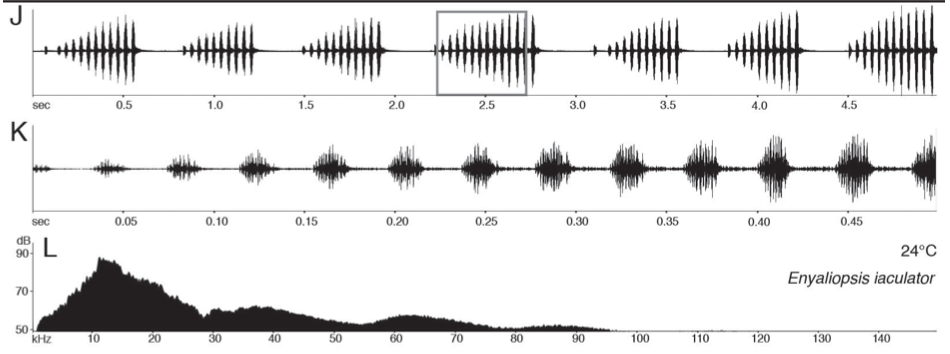
The call of E. iaculator is a continuous train of short but distinctly separate syllables, with syl- lables produced at the rate of only 2/sec (at 26°C); mean syllable duration is 0.04264 (SD=0.13340, n=790), with the frequency peak at 11.7–14.6 kHz (Figs. 49I–L); each syllable consists on average of 11 impulses (SD=2.101, n=104). The call is loud and readily audible to the human ear from several meters. Males usually start calling shortly after sunset from dense bushes, often very low to the ground (from a few centimeters to about 3 meters above the ground.) While calling, the male invariably hangs upside down on a thin branch and is relatively oblivious to disturbance. Calling males appear to be territorial and are spaced regularly by at least 10 m; the same tree or bush never has more than one calling male. The population in the northeastern part of the Cheringoma Plateau is unusual in that the males often sing throughout the day, including noontime. This population, however, shows no statistically significant differences from the populations elsewhere in the Gorongosa region in either the parameters of the call or their morphological characters.
this account at bio.acousti.ca
general · bio.acousti.ca
stridulatory file weakly sinuous, 2.9–3.1 mm long, 0.14–0.2 mm wide, with 53–60 teeth (Fig. 19A).
10 measurements across 10 traits. Each name links to its term in the audioBlast vocabulary.
Every value behind the summaries above. Each links to its own record in the API, which carries the reference it was taken from.
| Trait | Value | Call | Part | Sex | Temp. | Source |
|---|---|---|---|---|---|---|
| Individual spacing while calling (m) | >10 | Calling Song | Male | bio.acousti.ca | ||
| Impulses per syllable | 11 | Calling Song | Male | bio.acousti.ca | ||
| Syllable Repetition Rate (Repeated Syllables in Song) | 2 | Calling Song | Male | 26 | bio.acousti.ca | |
| Calling height (m) | <3 | Calling Song | Male | bio.acousti.ca | ||
| Time Of Day Of Call | After sunset | Calling Song | Male | bio.acousti.ca | ||
| Syllable Duration (song is syllable sequence) | 0.04264 | Calling Song | Male | 26 | bio.acousti.ca | |
| Width of Stridulatory File | 0.14-0.2 | Male | bio.acousti.ca | |||
| Number Of Teeth On Stridulatory File | 53-60 | Male | bio.acousti.ca | |||
| Peak Frequency (kHz) | 11.7-14.6 | Calling Song | Male | bio.acousti.ca | ||
| Length Of Stridulatory File | 2.9-3.1 | Male | bio.acousti.ca |
Oscillograms, traces and photographs held against this taxon.
Counts are recordings at or below each taxon, so an empty branch shows as empty before you click it. A dash means the join view holds no column for that rank and cannot roll up to it.
Publications audioBlast links to this taxon.
The rows audioBlast holds for this taxon, each matched to the same Catalogue of Life node. Where a source classifies it differently, its own classification is kept.
| Source | Its name | Its rank | Its family | Record |
|---|---|---|---|---|
| bio.acousti.ca | Enyaliopsis iaculator | Species | Tettigoniidae | bio.acousti.ca/6919 |
Bioschemas is in the head of this page. The Darwin Core RDF lives at the API address below, which negotiates JSON-LD and Turtle.
{
  "@context": [
    "https://schema.org/",
    {
      "dwc": "http://rs.tdwg.org/dwc/terms/"
    }
  ],
  "@type": "Taxon",
  "@id": "https://browse.acousti.cloud/taxon/enyaliopsis-iaculator/",
  "name": "Enyaliopsis iaculator",
  "taxonRank": "species",
  "url": "https://browse.acousti.cloud/taxon/enyaliopsis-iaculator/",
  "sameAs": "https://api.audioblast.org/taxon/CoL/8PYKW",
  "parentTaxon": {
    "@type": "Taxon",
    "name": "Enyaliopsis",
    "taxonRank": "genus",
    "url": "https://browse.acousti.cloud/taxon/enyaliopsis/"
  }
}