Figures
Oscillograms, traces and photographs held against this taxon.



What the sources say about this taxon, as written.
behaviour · bio.acousti.ca
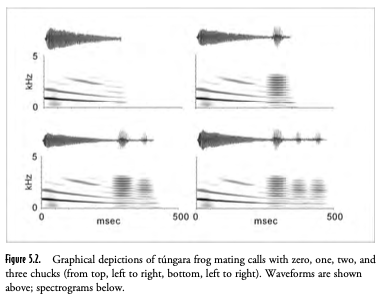
All túngara frog mating calls have a fundamental frequency that sweeps from about 900 to 400 Hz in about 300 milliseconds (Figure 5.2). The frequency sweep, or “whine,” has several harmonics, but about half of the call’s energy is in the fundamental frequency. The dominant frequency is about 700 Hz. A mating call can consist of the whine only, or there can be an additional component consisting of shorter bursts of sounds, “chucks,” added to the end of the whine. Calls with chucks are referred to as complex calls. A chuck has a funda- mental frequency of about 220 Hz with substantial energy in each of the 15 harmonics of the fundamental. The dominant frequency of a typical chuck is about 2,500 Hz with a duration of approximately 35 milliseconds. A túngara frog mating call can contain from zero to seven chucks. The complex call of the túngara frog is an unusual acoustical feat, and males accomplish this with an unusual larynx (Figure 5.3). Frogs produce calls by passing air from the lungs through the larynx, where it vibrates a pair of vocal folds and produces the pressure fluctuations that are perceived as sound. Many species of frogs have local thickenings or small fibrous masses on the vocal folds, which lower the frequency of vocal fold vibration and of the resulting ound. Túngara frogs have a pair of pendulous fibrous masses that hang from the vocal folds and protrude into the passageway that connect the lungs to the larynx. Male call production is socially regulated. Males calling in isolation usually produce only simple calls, while males in choruses are more likely to produce complex calls. Although males can produce calls with up to seven chucks, they rarely do so. In recordings of 85 males calling in choruses in the wild (Figure 5.4), 53 percent of the calls were simple, consisting of only a whine, while 37 percent had one chuck, 10 percent had two chucks, and 0.1 percent had had three or more chucks (Bernal, Page, et al., 2007). Males tend to increase and decrease call complexity one chuck at a time and add chucks in response to calls of other males (Bernal et al., 2009). In evoked- vocalization studies using static stimuli, in which the same call is broadcast to the male at a natural calling rate, males produced more chucks in response to complex calls than to simple calls but tended not to produce more chucks in response to stimuli with more versus fewer chucks (Bernal et al., 2009). In response to dynamic playbacks, in which a computer program counted the number of chucks in the male’s call and then responded with a specified call- ing strategy, males produced more chucks when the playback always produced one more chuck than the male (“escalate strategy”) than in response to a play- back that always produced one less chuck than the focal male (“deescalate strategy”; Goutee et al., 2010). Thus the male’s call complexity is influenced by calling strategies of other males. In experiments using both static and dynamic playbacks the number of chucks produced is low, less than two, and as in the field is far lower than the maximum number of chucks that males are able to produce. Females also influence a male’s call complexity (Akre & Ryan, 2011). In nature males tend to remain fairly stationary while calling, and females are able to approach a male unencumbered by any interference. Females choose a male by slowly moving into the male, at which time he clasps her from the top in amplexus. They remain in this state for several hours before constructing a foam nest. Anecdotal observations suggested that males can detect the approach of a female, perhaps by detecting the vibrations of the female as she swims through the water, and increase the number of chucks in response. Detailed behavioral observations have shown that females possess a repertoire of behaviors in the presence of males that do not function in mate choice directly, that is, approaching and initiating amplexus with a male, but seem to function in dis- play manipulation. In these cases females might rapidly swim past a male, bump a male and rapidly swim away, leap over a male, or splash in his vicinity. All of these behaviors and more (seven specific behaviors were identified) result in males increasing the number of chucks he produces (Akre & Ryan, 2011). Sexual selection by female choice has driven the evolution of complex calls in túngara frogs. Even though males seem to be reluctant to produce complex calls, needing to be persuaded by male vocal competition or female manipula- tion, experiments show that females are five times more likely to choose a syn- thetic whine-chuck over a simple whine. Addressing the question more subtly, we have also shown that in 14 of 20 cases a male increases his attractiveness when he adds a chuck to his call (Baugh & Ryan, 2010b). The differences among males in the potency of their chucks is due to the amplitude of the chuck. Males can vary chuck amplitude independent of whine amplitude, and they must produce a chuck that is at least the same peak amplitude of the whine for females to prefer this complex call to the simple call. Not only do chucks make a call more attractive, they can also make it more memorable (Akre & Ryan, 2010a). Most frogs and insects call in unison-bout choruses; that is, individuals initiate and cease calling more or less at the same time. In túngara frogs, choruses average about 50 seconds in duration and are separated by about 25 seconds of silence. Is the female able to remember a call over that silent interval, and if so, does call complexity influence for how long the call is remembered—what we refer to as the call’s active time? The experi- ments to address this question were simple. A female was tested in an acoustic chamber placed equidistant between two speakers. She was restrained inside a mesh funnel so she could hear the calls but could not move toward them. First the female was exposed to a simple call broadcast from one speaker and a com- plex call from the other speaker. These broadcasts then ceased, and there was a period of silence. The broadcasts were then resumed, but a simple call now emanated from each speaker. The null hypothesis of no memory is that the female should be equally likely to approach either speaker, regardless of which one had previously been broadcasting the complex one. If the female remem- bered which speaker had been broadcasting the complex call, she should approach that one. When the complex call had one chuck, there was no memory. If the com- plex call had three chucks, then the female was attracted to the speaker that had previously broadcast the three-chuck call. The female remembered the call for up to 45 seconds; after 60 seconds there was a trend in preference for the complex call suggesting perhaps some weak memory, and there was no hint of a memory trace at 120 seconds. Thus adding additional chucks, or at least three chucks, to a call is favored by sexual selection because males are more likely to be remembered by females. These studies remind us that there are subtle ways a male can make himself more likely to be chosen as a mate. Female preference for more chucks versus fewer chucks is context depen- dent. Any sound decreases in amplitude with greater distance from its source. The active space of a signal is the area over which the signal is perceived by the receiver. We normally consider the active space of a signal, but we can also consider the active space of different signal components. Because signal ampli- tude varies with distance, we varied the signal amplitude to vary the perceived distance of the female from the calling male. The females’ preferences for chucks varied with distance (Akre & Ryan, 2010b). When the amplitude of the call at the site of the female was adjusted to mimic a call produced by a male 12 m away, females exhibited phonotaxis to the call, but they did not discriminate between a simple call and a complex call with either one or three chucks (Figure 5.5). At 3 m females preferred both complex calls (with one or three chucks) to simple calls, but they did not prefer calls with three chucks to calls with one chuck, nor did they exhibit memory for the complex calls. At 1 m females still preferred calls with one or three chucks to simple calls; they also preferred complex calls with three chucks to complex calls with one chuck; and they also exhibited memory for calls with three chucks. Thus we can think of the call having a stratified active space in which the potency of different components of the call varies with distance.
this account at bio.acousti.ca
behaviour · bio.acousti.ca
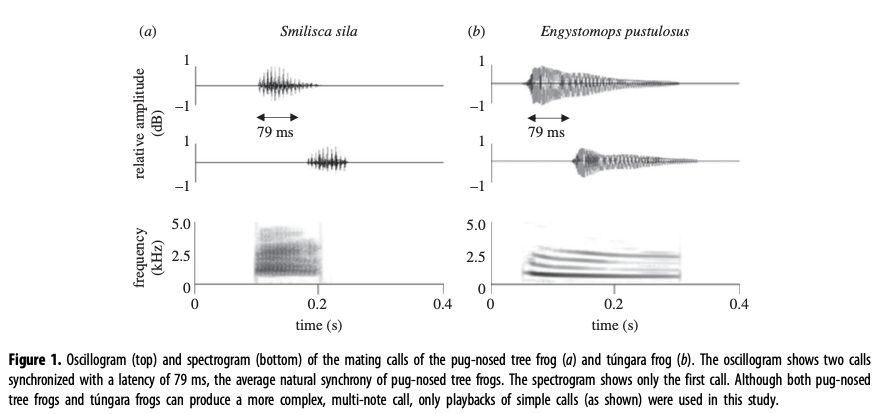
... pug-nosed tree frogs (Smilisca sila), in which males pro- duce mating calls in near-perfect synchrony, and túngara frogs (Engystomops pustulosus), in which males alternate their calls.
this account at bio.acousti.ca
behaviour · bio.acousti.ca
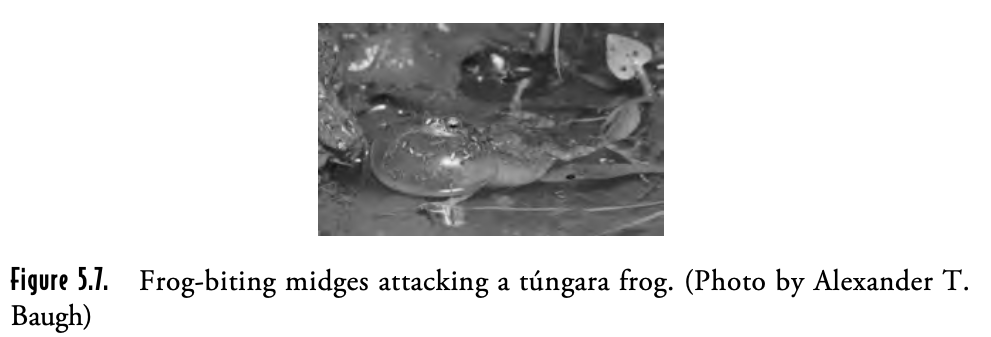
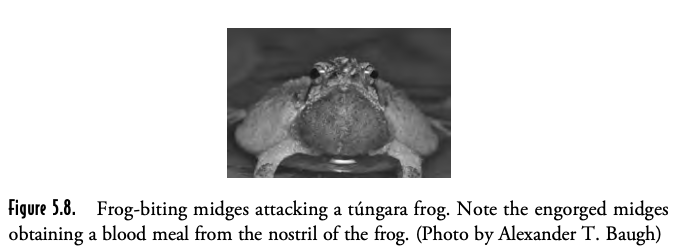
Frog-biting midge communities between seasons Sound traps broadcasting túngara frog calls were success- ful at attracting frog-biting midges both during the rainy and dry season (Table 1). During the rainy season, a total of 9052 corethrellids from eight species were captured using sound traps playing túngara frog calls. Significantly fewer midges were cap- tured using túngara frog calls in the dry season, a total of 3936 comprising six species (t-test, t = 3.37, P = 0.001; Table 2a). Both seasons were dominated by a single species, Corethrella ranapungens Borkent, which represented over 85% of the spec- imens identified in our samples. While the subdominant species differed between seasons [Corethrella edwardsi Lane (Lane, 1942) and Corethrella carariensis Borkent for the rainy and dry seasons, respectively], the difference between the subdominant species and the other less common species was slight in compar- ison. Only one species, C. carariensis, was more abundant in the dry season (48 collected) than in the rainy season (20 collected). Both Shannon diversity and Pielou’s evenness for frog-biting midges were slightly higher in the rainy season than in the dry season (Table 2b). The slopes of the ranked abundance curves, fitted using Zipf models (Table 2c), for the rainy and dry sea- sons were similar (Fig. 2a,b), suggesting that the relative abun- dances of the midge community are similar between seasons. Although there were two species absent from the dry season that were identified in the rainy season, Corethrella appendiculata Grabham (Grabham, 1906) and Corethrella belkini Borkent, these species were rare. Use of Beal’s smoothing to take into consideration the midges attracted to túngara frog calls in both seasons revealed a high probability that both C. appendiculata (66.08%) and C. belkini (76.78%) occur in the dry season and are attracted to túngara frog calls. Frog-biting midge communities feeding on different anuran species During the dry season, significantly fewer midges were attracted to pug-nosed tree frog calls (1253 individuals from seven species) than to túngara frog calls (3936 individuals from six species) (t-test, t = 5.19, P < 0.00001; Table 2a). Like tún- gara frog calls, C. ranapungens was the dominant species, rep- resenting 77.43% of the specimens we identified attracted to the calls of the pug-nosed tree frog. The difference between the less common species was more pronounced, with the subdominant species in the sample, Corethrella aurita Borkent, represent- ing 16.30% of the total sample. Corethrella aurita was also the only species attracted in greater numbers to pug-nosed tree frog calls than to túngara frog calls during the dry season, represent- ing only 3.20% of the individuals sampled attracted to túngara frog call. As a result of the slightly lower dominance of C. ranapungens, Shannon diversity and Pielou’s evenness were higher for midges attracted to pug-nosed tree frog calls than for those attracted to túngara frog calls (Table 2b). Furthermore, three midge species in the dry season attracted to pug-nosed tree frog calls were represented by only one individual. The slope of the ranked abundance curve, fitted using a Zipf–Mandelbrot model (Table 2c), was steeper than for the dry season túngara frog sample; however, this steepness is probably the result of the three species with only one individual (Fig. 2c). The steep initial slope between the first three most abundant species suggests a more uniform distribution in comparison to the midges attracted to túngara frog calls. As with túngara frog calls in the dry season, C. appendiculata was not detected in the midges attracted to pug-nosed tree frogs. Similarly, using Beal’s smoothing to take the rainy season datasets into consideration indicates that there is a high probability that C. appendiculata (67.35%) occurs in the dry season and is also attracted to pug-nosed tree frog calls.
12 measurements across 10 traits. Each name links to its term in the audioBlast vocabulary.
2 measurements · Calling Song (Chuck), Calling Song (Whine)
Every value behind the summaries above. Each links to its own record in the API, which carries the reference it was taken from.
| Trait | Value | Call | Part | Sex | Temp. | Source |
|---|---|---|---|---|---|---|
| Note Duration (Amphibia Demo) | 0.3 | Calling Song (Whine) | Male | bio.acousti.ca | ||
| 0.035 | Calling Song (Chuck) | Male | bio.acousti.ca | |||
| Dominant Frequency (Amphibia Demo) | 0.7 | Calling Song (Whine) | Male | bio.acousti.ca | ||
| 2.500 | Calling Song (Chuck) | Male | bio.acousti.ca | |||
| Chorus strategy (Amphibia Demo) | Alternate | Calling Song | Male | bio.acousti.ca | ||
| Time Of Year Of Call | April-November | Calling Song | Male | bio.acousti.ca | ||
| Fundamental Frequency (Amphibia Demo) | 0.220 | Calling Song (Chuck) | Male | bio.acousti.ca | ||
| Fundamental frequency start if call (Amphibia Demo) | 0.9 | Calling Song (Whine) | Male | bio.acousti.ca | ||
| Chorus interval (Amphibia Demo) | 25 | Calling Song | Male | bio.acousti.ca | ||
| Number of harmonics (Amphibia Demo) | 15 | Calling Song (Chuck) | Male | bio.acousti.ca | ||
| Chorus duration (Amphibia Demo) | 50 | Calling Song | Male | bio.acousti.ca | ||
| Fundamental frequency end of call (Amphibia Demo) | 0.4 | Calling Song (Whine) | Male | bio.acousti.ca |
438 in audioBlast.
426 more in the audioBlast browser.
Oscillograms, traces and photographs held against this taxon.
Counts are recordings at or below each taxon, so an empty branch shows as empty before you click it. A dash means the join view holds no column for that rank and cannot roll up to it.
Publications audioBlast links to this taxon.
The rows audioBlast holds for this taxon, each matched to the same Catalogue of Life node. Where a source classifies it differently, its own classification is kept.
| Source | Its name | Its rank | Its family | Record |
|---|---|---|---|---|
| iNaturalist | Engystomops pustulosus | Species | Leptodactylidae | iNaturalist/65448 |
| bio.acousti.ca | Physalaemus pustulosus | Species | Leptodactylidae | bio.acousti.ca/5973 |
| bio.acousti.ca | Engystomops pustulosus | Species | Leptodactylidae | bio.acousti.ca/6989 |
Bioschemas is in the head of this page. The Darwin Core RDF lives at the API address below, which negotiates JSON-LD and Turtle.
{
  "@context": [
    "https://schema.org/",
    {
      "dwc": "http://rs.tdwg.org/dwc/terms/"
    }
  ],
  "@type": "Taxon",
  "@id": "https://browse.acousti.cloud/taxon/engystomops-pustulosus/",
  "name": "Engystomops pustulosus",
  "taxonRank": "species",
  "url": "https://browse.acousti.cloud/taxon/engystomops-pustulosus/",
  "sameAs": "https://api.audioblast.org/taxon/CoL/39TTY",
  "alternateName": [
    "Túngara frog"
  ],
  "parentTaxon": {
    "@type": "Taxon",
    "name": "Engystomops",
    "taxonRank": "genus",
    "url": "https://browse.acousti.cloud/taxon/engystomops/"
  }
}