Figures
Oscillograms, traces and photographs held against this taxon.
What the sources say about this taxon, as written.
behaviour · bio.acousti.ca
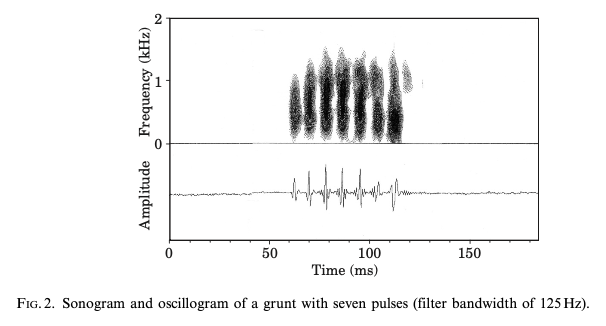
Grey gurnards emitted three sound types during competitive feeding: knocks, grunts and growls (Figs1-3). A discriminant analysis based on the measured acoustic features supported the adequacy of this classification (n = 1080, Wilks λ= 139, P<0.001). Single-pulse knocks were not considered in this analysis since these do not have values for the variable pulse period. More than 90% of the knocks and grunts, and 73% of the growls were correctly classified (Table I). The variables that mainly contributed to the discriminant functions were the pulse duration, the number of pulses and the pulse period (Table II). Pulse duration was shorter in growls than in knocks or grunts, probably due to a shorter pulse period (TableIII). Sound duration and number of pulses increased from knock to grunt to growl. Most knocks had one or two pulses (85%), typical grunts had four to eight pulses (87%) and typical growls 10 to 40 pulses (59%). The peak frequency of all sound types was c. 500 Hz (Table III). Knock and grunt bursts typically lasted for a little over a second and usually consisted of five consecutive sounds (Table III). Knocks were the most frequent sound type [mean' ± S.D. (range): 9.8±8.6 (0-32.8) knocks min-1] during the 5min feeding bouts (n = 64). Growls occurred rarely [0.3'±0.7 (0-3.8) growls min-1], usually within or at the end of grunt bursts [4.6±4.6 (0-21.6) grunts min-1]. Only 64 growls were recorded during this study.
Oscillograms, traces and photographs held against this taxon.
Counts are recordings at or below each taxon, so an empty branch shows as empty before you click it. A dash means the join view holds no column for that rank and cannot roll up to it.
Publications audioBlast links to this taxon.
The rows audioBlast holds for this taxon, each matched to the same Catalogue of Life node. Where a source classifies it differently, its own classification is kept.
| Source | Its name | Its rank | Its family | Record |
|---|---|---|---|---|
| bio.acousti.ca | Eutrigla gurnardus | Species | Triglidae | bio.acousti.ca/8001 |
Bioschemas is in the head of this page. The Darwin Core RDF lives at the API address below, which negotiates JSON-LD and Turtle.
{
  "@context": [
    "https://schema.org/",
    {
      "dwc": "http://rs.tdwg.org/dwc/terms/"
    }
  ],
  "@type": "Taxon",
  "@id": "https://browse.acousti.cloud/taxon/eutrigla-gurnardus/",
  "name": "Eutrigla gurnardus",
  "taxonRank": "species",
  "url": "https://browse.acousti.cloud/taxon/eutrigla-gurnardus/",
  "sameAs": "https://api.audioblast.org/taxon/CoL/6HKHX",
  "alternateName": [
    "Grey gurnard"
  ],
  "parentTaxon": {
    "@type": "Taxon",
    "name": "Eutrigla",
    "taxonRank": "genus",
    "url": "https://browse.acousti.cloud/taxon/eutrigla/"
  }
}